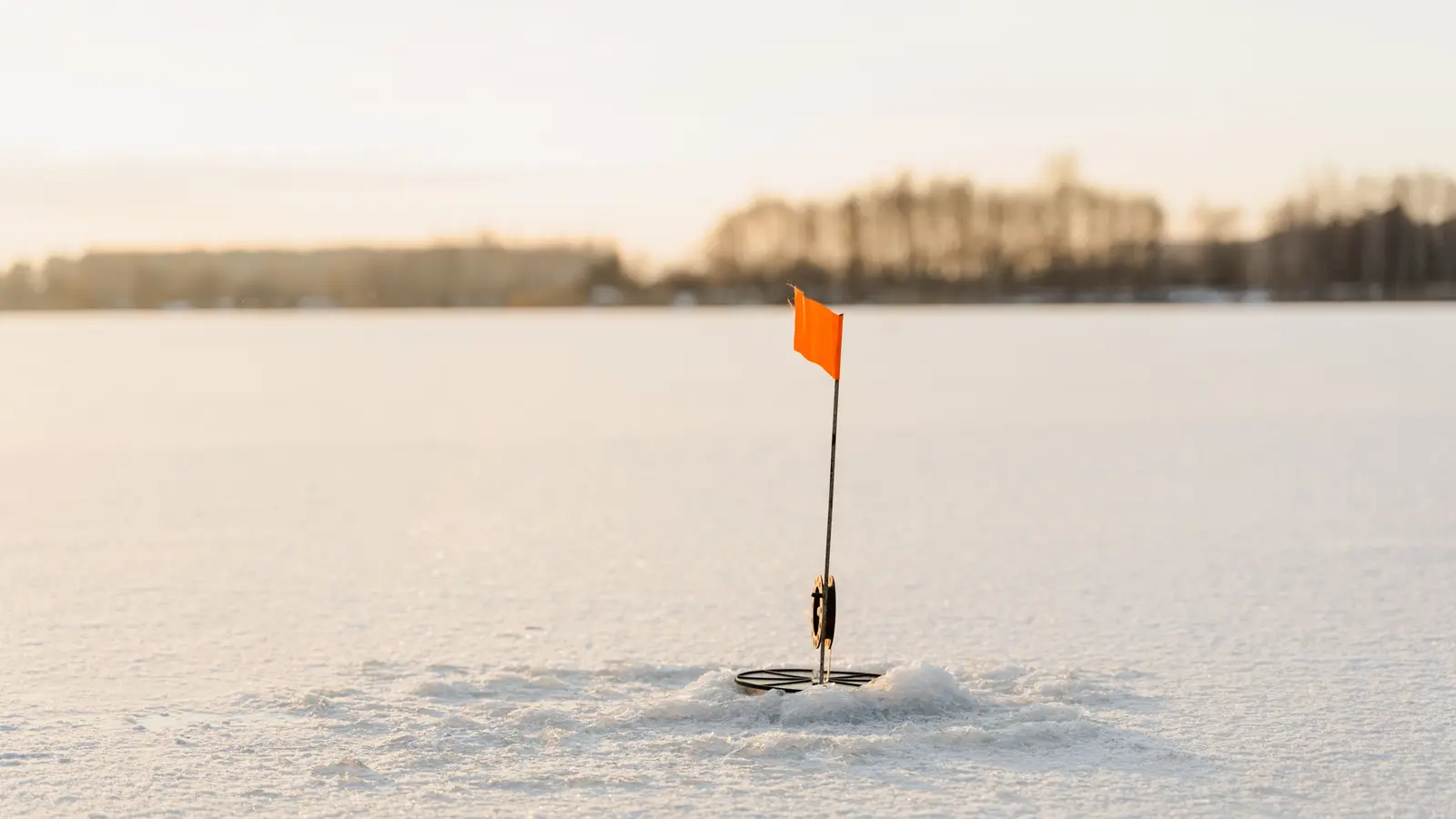
In Maine, a trap is a tip-up: a frame over the hole that holds your line and flips a flag up when a fish takes the bait. General law lets you fish five lines through the ice, traps and jigging rods counted together, and two on waters marked S-8. Every line has to stay under your immediate supervision. Here are the rules, how to set a trap the way IF&W describes it, and which traps to buy, including the Maine makers who sell direct.
The short answer
- Five lines per person in most waters, traps and rods together. S-8 waters allow two.
- Stay with them. The law says immediate supervision and gives no distance.
- No lead sinkers or jigs of 1 ounce or less, or 2.5 inches or less, on inland waters.
The trap rules for 2026
- 5 Lines per person The 2026 law book: "At no time may an angler fish with more than five lines." Traps and jigging rods count together.
- 2 Lines on S-8 waters Special law S-8 restricts a water to two lines per person. A few waters change that, such as five lines at night for cusk.
- Immediate supervision Every line stays under the immediate supervision of the person who set it. The law gives no distance, so stay where you can watch your flags.
- Night cusk lines Waters open to fishing are open around the clock. Lines set for cusk at night must be visited at least once every hour.
- No name on traps The 2026 law book has no marking rule for traps. A shack needs the owner's name and address on the outside, in letters 2 inches tall.
- One hook, except smelts Fish a single baited hook per line. When you fish for smelts, the law book allows any number of baited hooks.
Where you can set traps depends on the zone. South Zone lakes and ponds are open to ice fishing all year, while North Zone lakes and ponds are closed from October 1 to March 31 unless a special law opens them, as it does for Moosehead from January 1. Our Maine ice fishing guide shows the months, and IF&W’s FLOAT map has each water’s own rules.
Wooden traps or round tip-ups
Maine anglers mostly fish two kinds of trap. The traditional one is wooden, with a cross or rail base and a tall flag. The other is a round tip-up that sits on the hole like a lid.
The Maine classic
Wooden trap
- Tall flags: Forest City says its flags stand close to 36 inches above the ice
- Big reels: 300 feet of line or more on several Maine-made traps
- Sold direct or in tackle shops. We found none on Amazon
For cold days
Round thermal tip-up
- Covers the hole, and the insulated ones slow ice forming
- Frabill's Pro Thermal 1662 fits in a 5 to 6 gallon bucket
- Sold on Amazon, and some come with line and a flag light
How to set a trap
IF&W’s beginner’s guide rigs a trap this way: your ice fishing line, a piece of monofilament, a swivel, then another piece of monofilament with the hook. Add “a small, nonlead weight to the leader as needed.” Its go-to hook is a #6, or a #8 when you fish small smelts for salmon, and a larger hook for togue.
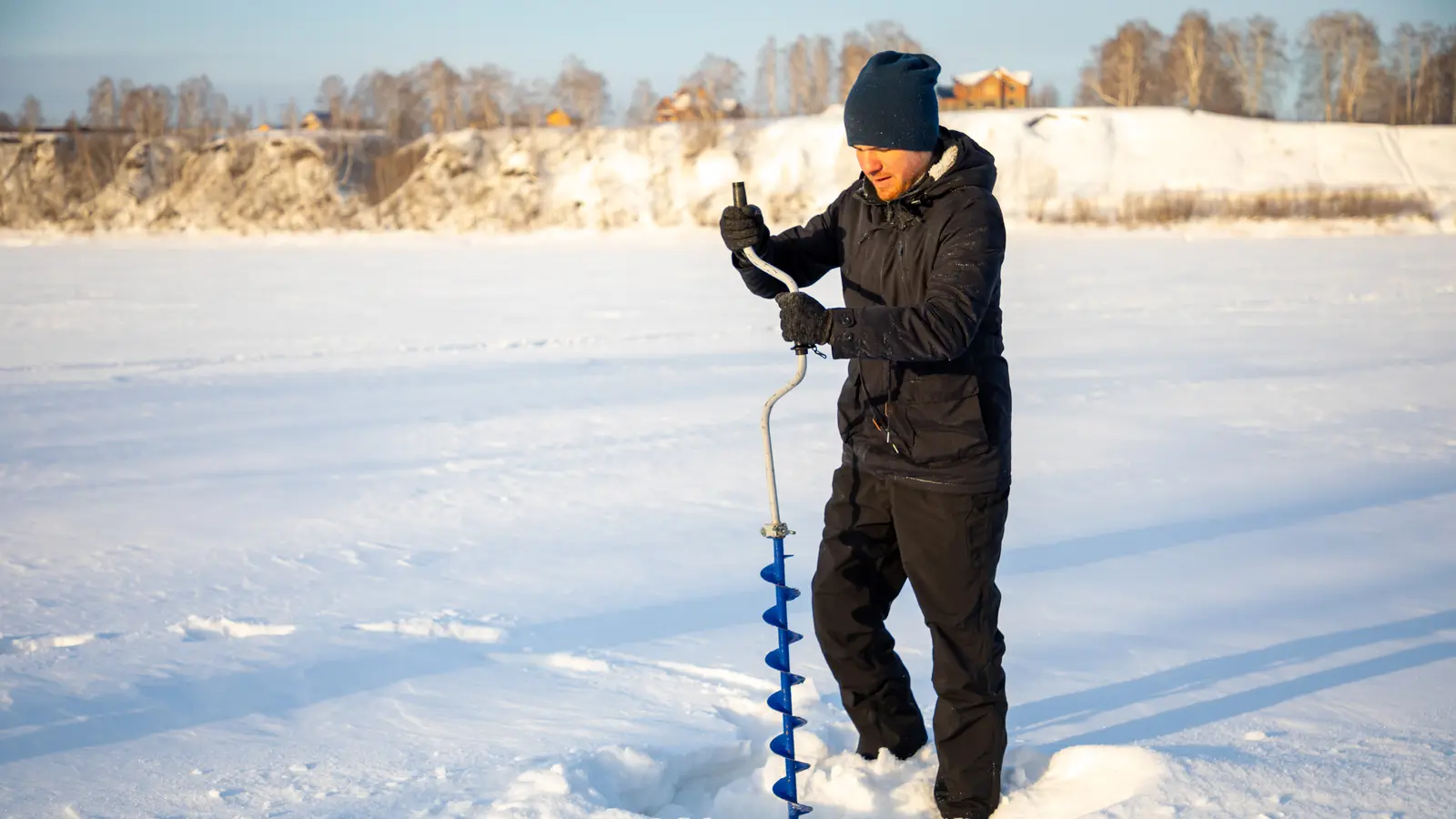
- Drill and clear the hole Drill, then skim out the ice chips so the line runs clean.
- Find the bottom Clip a depth sounder on the line, hold the trap and lower the line. When it goes slack, you have found the bottom.
- Set the depth IF&W says most fish are "just a few feet under the ice or up a few feet off bottom." Pick one and note it.
- Bait the hook Hook a legal baitfish or a worm so it is secure and won't wiggle off.
- Check the trip Make sure a pull on the line trips the flag. If it doesn't, the line may be wound on the reel the wrong way.
- Set the flag and watch Set the flag, then stay where you can see every trap you set.
When the flag goes up
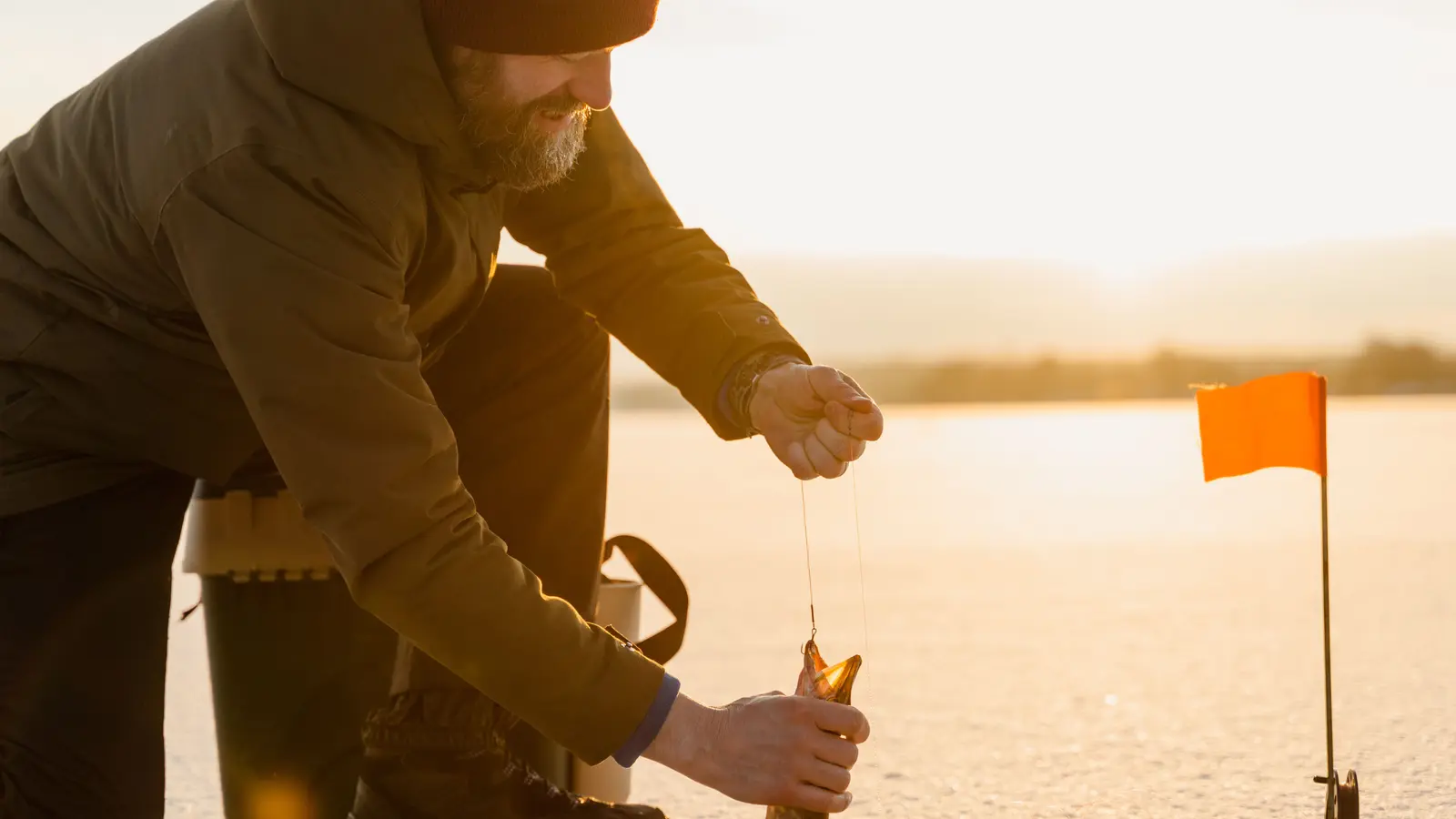
IF&W’s advice is to go easy: “Gently pick up the trap and grab the line. A short, quick tug on the line will set the hook.” Then bring the fish in hand over hand, letting it take line if it runs. Measure before you keep anything. These are the general-law limits for lakes and ponds in the 2026 law book; special laws often lower them.
| Fish on your traps | Daily limit | Minimum length |
|---|---|---|
| Togue (lake trout) | 2 | 18 in |
| Landlocked salmon | 2 | 14 in |
| Brook trout | 5, or 2 from South Zone lakes and ponds | 6 in |
| Chain pickerel | No limit | None |
| Redfin pickerel | No fishing permitted |
Bait and lead
The South Zone allows live bait. All legal forms of bait are allowed, including live baitfish and smelts.
The North Zone bans live fish as bait. Worms and dead baitfish or smelts are fine. Waters marked S-11 allow live baitfish and smelts again, and waters marked ALO (artificial lures only) or FFO (fly fishing only) allow no bait at all.
Only listed baitfish and smelts. The law book lists the legal baitfish, from golden shiners to white suckers, and says baitfish and rainbow smelt “are the only fish species that may be used as bait.” Never dump leftover bait into the lake or down the hole, and never bring live bait in from out of state. To catch smelts yourself, through lake ice or at a tidal smelt camp, see our Maine smelt fishing guide.
No small lead since September 1, 2026. Maine bans using a lead sinker or lead jig that weighs 1 ounce or less, or measures 2.5 inches or less, on inland waters, painted or not. Clip-on ice-fishing depth sounders are not counted as sinkers. Use tin or tungsten weights, and see IF&W’s lead tackle page.
Which tip-ups to buy: Maine wooden traps, Beaver Dam or Frabill
IF&W’s beginner’s guide names Heritage and Jack Traps as Maine-made brands. All three makers below sell direct or through tackle shops, and we found none of them on Amazon.
| Maker | Made in | What they make | How to buy |
|---|---|---|---|
| Jack Traps | Monmouth | Wooden standard and cross traps from 20 to 43 in, with 3 or 4 in reels | Their Monmouth store, jacktraps.com or 207-933-9499 |
| Heritage Tackle | Eddington, per its retailers | The Laker Classic, a 36 in wooden cross-base trap, and the Laker Heavy Duty | Tackle shops, Sportsman’s Warehouse and FishUSA |
| Forest City Traps | Forest City | Handmade red oak cross and H-style traps with 4 in aluminum reels | Order by email, pay a PayPal invoice and allow three weeks |
Jack Traps lists its most popular trap, the 26 in standard with a 4 in reel, at $65, and takes $2 off each trap when you buy five or more. Forest City’s 2026 price sheet has its cross-style trap at $93.60. Check their sites for current prices.
On Amazon, Beaver Dam’s wood-board trap is the closest thing to a Maine wooden trap, Frabill’s tall stick trap suits deep snow, and the round thermal tip-ups are the ones to buy for very cold days.
Pick by the day you fish. Deep snow on the ice favors a tall flag you can see over drifts, which is what Frabill’s stick trap is built for. Below-zero mornings favor a thermal tip-up, whose cover slows the hole freezing over between flags, or Frabill’s VYPR, which adds an aerator. A first set of traps is easiest as Frabill’s 1662 thermal, which comes with a flag light, 50 yards of line and a depth finder. And if you like the look and feel of a Maine trap but want to order online, Beaver Dam’s wood-board design is the one.
Lights and line. Flags that go up near dusk are easy to miss, so a clip-on flag light pays for itself if you fish the last hour. Tip-up braid that changes color every 5 feet lets you set every trap at the same depth, and a few feet of fluorocarbon leader finishes the IF&W-style rig: trap line, swivel, leader, hook. All of these are in the kit below.
The rest of an ice kit, from augers and shelters to a heater and sonar, is on our Maine ice fishing gear page. Drilling five holes with a cordless drill? Our drill ice auger guide covers the drill it needs.
Common questions
How many ice fishing traps can I use in Maine?
Five lines per person in most Maine waters, with traps and jigging rods counted together. Waters marked S-8 in the law book allow two lines, and a few waters have their own limits.
How far can I be from my traps in Maine?
Maine law says every line must be under the immediate supervision of the person who set it, but it gives no distance. Stay where you can watch your flags and get to a trap quickly. Night cusk lines must be visited at least once an hour.
Do ice fishing traps need my name on them in Maine?
The 2026 law book has no name rule for traps. Ice shacks are different: the owner's name and address go on the outside in 2-inch letters.
Can I use live bait on traps in Maine?
In the South Zone, yes, using baitfish on the state list or smelts. North Zone general law bans live fish as bait, though dead baitfish, smelts and worms are allowed and some waters permit live bait by special law.
Which tip-up should I buy for Maine?
For deep snow, a tall-flag stick trap like Frabill's. For below-zero days, an insulated thermal tip-up, which slows the hole freezing over. For a first set, Frabill's 1662 thermal comes with a flag light and line. For a traditional wooden trap, Jack Traps, Heritage and Forest City sell direct, and Beaver Dam's wood-board trap is on Amazon.
Where can I buy Jack Traps?
From the Jack Traps store in Monmouth, Maine, at jacktraps.com or by phone at 207-933-9499. We found no Amazon listing for them.